
Your Website Is Your Best Employee. Treat It Like One.
Most website projects start with a mood board. Colors, fonts, photos, a few sites you like. Those choices matter, but they answer the wrong first question. The question that decides whether your website earns its keep is simpler: what is this site supposed to do for my business every single day?
If you can't answer that in a sentence, the site is a brochure. A good-looking brochure, maybe, but a brochure.
Think of your website as a hire
Imagine writing a job description for your website the way you would for a new team member. Not "look professional." Real duties:
Attract the right people and screen out the wrong ones
Answer the questions you answer ten times a week
Collect what you need to know before a first conversation
Book the call, take the payment or start the signup
Hand the new client or member to your team with everything they need
Follow up when someone goes quiet
Most small business sites only do the first item, and they do it with a gallery of photos and a contact form. Everything after that lands on you, usually at the end of a long day, as a pile of emails asking "can you send me a quote?"
Your best employee shows up at 11 PM on a Sunday and still handles it. That is the standard worth building toward.
Start with the work, not the pages
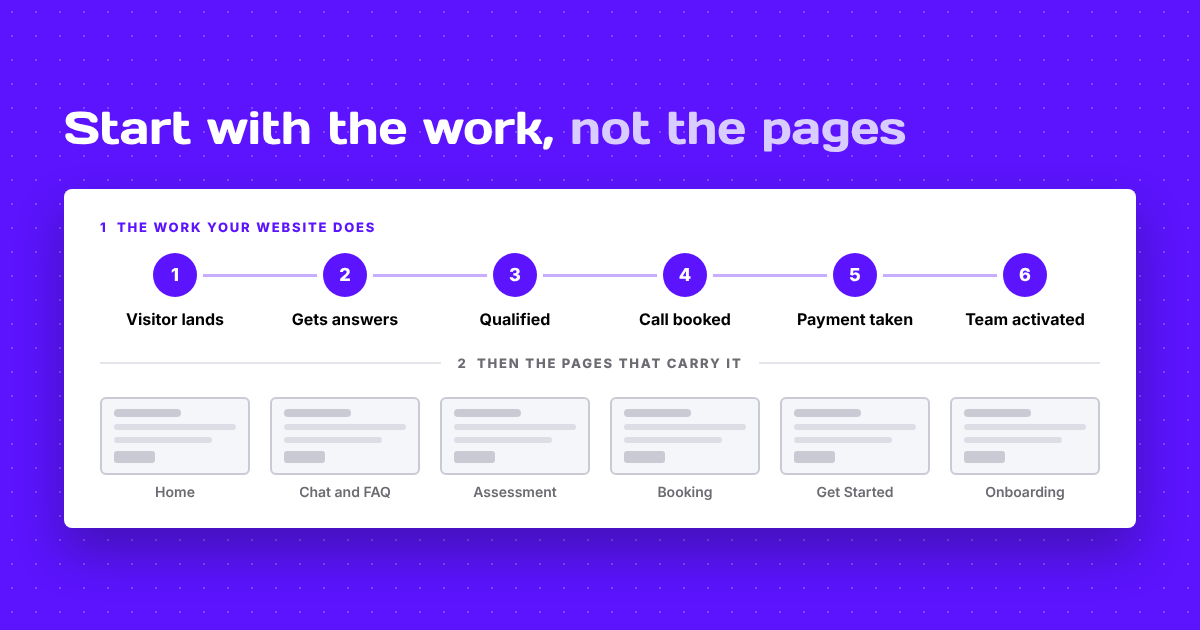
Before anyone opens a design tool, write down what happens from the moment a stranger lands on your site to the moment they are a client and your team is activated. Then ask:
Who handles each step today, and how long does it take?
Which steps repeat every time, with only the details changing?
Where do leads go cold because nobody followed up quickly enough?
What do you wish you knew about a person before the first call?
The answers are your blueprint. The pages, forms, calendars, emails and automations all come from that map. Skip the map and you end up with pages first and a scramble to bolt systems onto them later, if that ever happens at all.
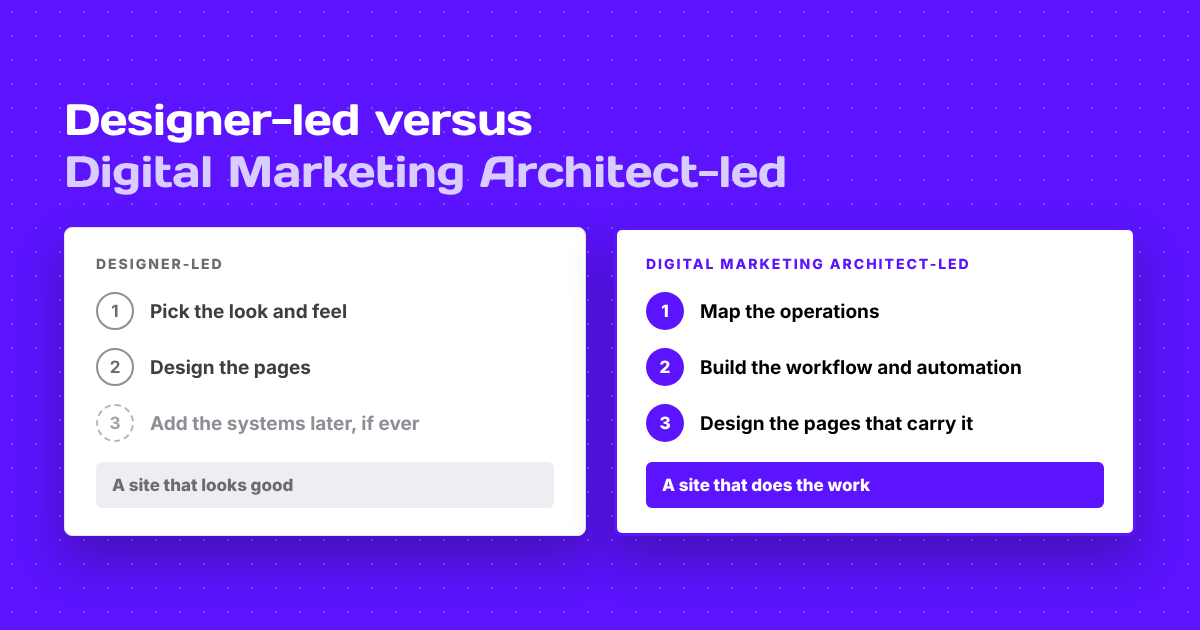
Designer-led versus Digital Marketing Architect-led
A graphic designer is trained to make things look right, and that is a real skill. I work with designers and I would not want to lose one. But there is a difference between designing a website and architecting one.
A designer-led project usually begins with the look and ends with a set of pages. The systems that make the site useful, like intake, qualification, booking, payment, follow-up and handoff, are treated as extras or as someone else's job.
An architect-led project begins with operations. The builder maps the workflow first, decides what the site has to do, and only then lays out the pages that carry it. Design still matters, and it gets better because every element has a job. It is the visible surface of a system, not the system itself.
The order matters because it is much harder to retrofit a working system into a finished design than to design beautifully inside a working system.
Where AI belongs in this
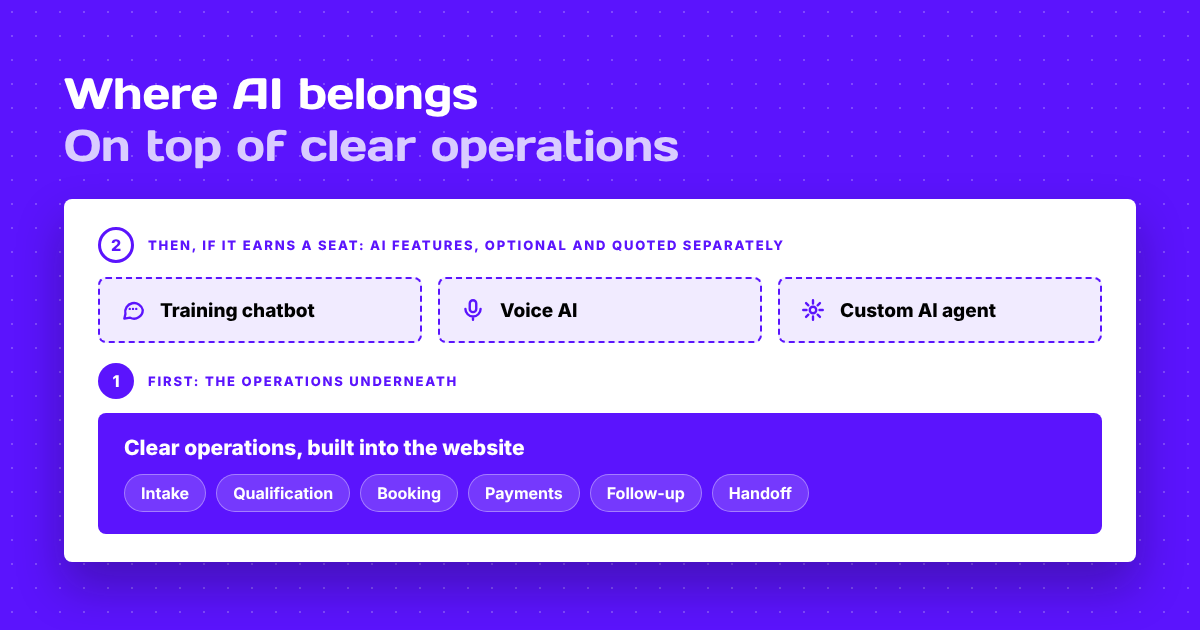
AI is useful in specific places. A chatbot trained on your own material can answer the common questions. Voice AI can pick up a call you would otherwise miss. AI can draft a follow-up or summarize an intake form so your team starts with context.
But AI placed on top of unclear operations just makes a mess faster. Get the operations right first, then decide where AI earns a seat. That is why I treat AI features as a separate, optional layer on top of a solid base build instead of the starting point.
What this looked like for my own website
My own website was a brochure, too. I took it down and parked the domain while I worked behind the scenes on a different approach. I started with the same operations questions I just gave you.
The result is a site where visitors can prequalify themselves without me. They take a short assessment, and my team and I see what matters to them before we speak. The investment is already on the page, so I am not writing custom quotes for people who were never a fit. When someone is ready, they sign the agreement and make their first payment online, and my team is activated. It is still evolving, but it already does work that used to land on my desk.
Five questions to ask about your current site
If a stranger arrives at 11 PM, what is the next step, and who handles it?
Does the site tell you what you need to know before a first call?
Can a ready buyer pay or sign without emailing you first?
When someone fills out a form, what happens in the next five minutes without a person doing anything?
Can you or your team edit the site without waiting on a developer?
If you answered "I do it" or "nothing" to most of these, your website is not doing the work of an employee yet. The good news is that this is a design problem you can solve in the right order.
Where to go from here
If you want help seeing what your site should be doing, start with the Website Assessment. It takes a few minutes, and it ends with a discovery call where we go over your answers together. If you want to put numbers on it first, the ROI calculator shows how quickly one connected system can cover its cost. And if you would rather just talk, you can book a call.